
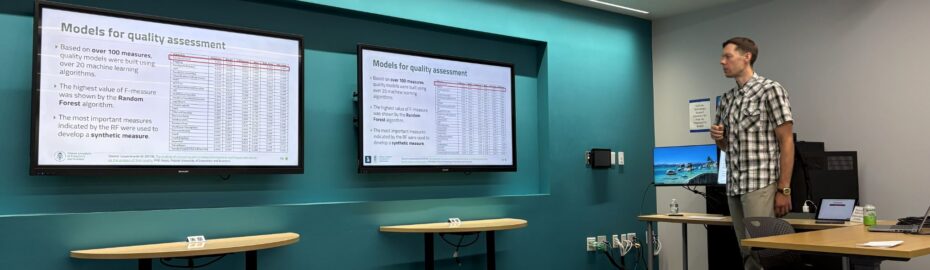
Is a Wikipedia article equally good in every language? How can we determine which information is most reliable and which sources are worth trusting? These questions were at the heart of an invited talk titled “Methods and Tools for Automatic Quality Assessment of Wikipedia Articles and Their Information Sources”, delivered at Arizona State University.
Wikipedia is one of the world’s most widely used sources of information, but its language editions do not always offer the same level of detail or up-to-date content. The same topic may be covered quite differently in the English, Polish, or German editions of Wikipedia. These differences go beyond article length to include the scope of information, how current it is, and the quality of the sources cited. So how can we compare millions of articles across languages and identify those that provide the most valuable information? Automated data analysis methods can help address this challenge.
The talk presented research findings and practical tools designed to assess and compare the quality of information on Wikipedia. One of these tools is WikiRank, a system that automatically assesses the relative quality and popularity of articles across different language editions. Another is BestRef, which enables the analysis and evaluation of information sources cited in Wikipedia articles.
These tools can benefit not only readers looking for more reliable information but also Wikipedia editors and researchers. They can support research into information quality, multilingual knowledge resources, digital humanities, and the use of artificial intelligence to analyze large datasets.
The invited talk took place on September 11, 2026, at Arizona State University as part of the activities of the AI and Multilingualism Lab and the Digital Humanities group. Arizona State University is one of the largest public universities in the United States.