
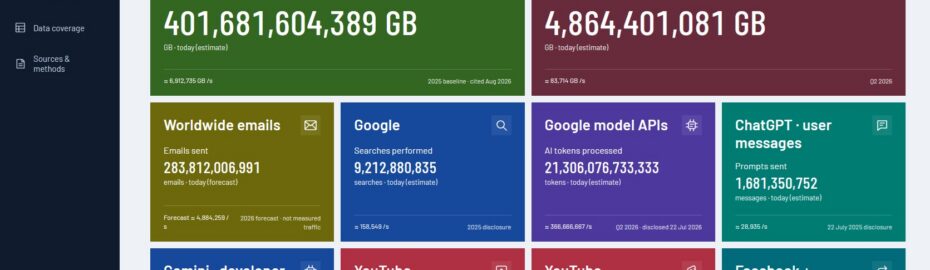
Every day, billions of people use the internet to search for information, communicate, watch videos, and interact with artificial intelligence tools. The scale of this activity is difficult to imagine. How much happens across the global internet in just one second? Internet Stats, an interactive website presenting statistics about the digital world, helps answer this question.
The internet has become an integral part of modern life. We use it for education, research, work, communication, and entertainment. Behind every message sent, search performed, or video watched are processes involving data transmission and processing. Although individual actions may seem insignificant, together they generate an enormous volume of digital activity worldwide.
One Second on the Internet: Millions of Digital Events
Just how extensive is this activity? According to information published by Google in May 2025, its search engine handles more than 5 trillion searches annually. In June 2026, LinkedIn reported that users worldwide submit an average of 10,000 job applications per minute through its platform. These are just two examples illustrating the remarkable scale of online activity.
Internet Stats presents similar data in an engaging, interactive format. The website provides statistics covering a wide range of topics, including:
- internet traffic and data transmission,
- social media activity,
- search engine usage,
- the development and use of artificial intelligence,
- electronic communication,
- e-commerce,
- digital infrastructure and cybersecurity.
Animated counters allow visitors to observe how quickly the estimated values of individual indicators increase.
Are the Figures Measured in Real Time?
From a scientific perspective, the methods used to generate these statistics are particularly interesting. Most of the counters do not represent direct measurements of internet activity collected in real time. Instead, their values are calculated using data published by technology companies, institutions, and research organizations. For example, if we know the number of events recorded over a given period, we can calculate their average frequency and estimate how many occur per second.
However, it is important to remember that a statistical average does not necessarily reflect the actual number of events occurring in any given second. Online activity varies depending on the time of day, geographical region, and many other factors. Internet Stats provides information about its data sources, the periods covered, and the methods used for its calculations.
Statistics as a Tool for Understanding the Digital World
Internet Stats offers more than just interesting facts and figures. It can also serve as a valuable educational resource, helping users better understand the role of quantitative data, data visualization, and statistical methods in analyzing contemporary phenomena. It also provides an opportunity to reflect on data reliability and the ways in which statistical information should be interpreted.
Understanding the digital world today requires not only the ability to use technology but also the skills needed to critically evaluate the information it provides. Internet Stats demonstrates how numerical data can serve as a starting point for exploring the complexity of the modern world and developing the competencies essential for navigating an increasingly digital society.
Website: internet-stats.com