
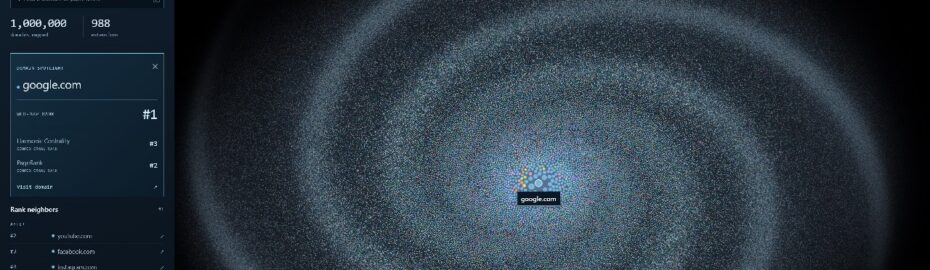
We usually encounter the web one page at a time. Web Map offers a different perspective: one million domains brought together in an interactive spiral galaxy. Search for a familiar address, select its star, and discover how it ranks when several sources of data are brought together.
Familiar online services stand out near the center, surrounded by a much larger population of less prominent domains. For students, researchers and curious internet users, this landscape offers an accessible way to explore how online popularity and visibility are measured.
One million domains is a large collection, but it represents only a small part of the web. For comparison, Netcraft’s September 2026 Web Server Survey recorded responses from approximately 1.47 billion sites across 323 million domains. Its total site count is broader than its separate count of active sites.
Reading the web as a galaxy
Each circle represents a domain: an address such as wikipedia.org. The highest-ranked domains occupy the core and have the largest circles. Lower-ranked domains spread outward along and between four spiral arms. Colors distinguish 988 domain extensions, including .com, .org, .pl and .wiki.
The spiral shape is a way of arranging the ranking. Two nearby circles do not necessarily represent domains that link to each other, cover similar topics or belong to the same organization. Their positions do not indicate geographical locations, and a country-code extension does not establish where a website’s audience or servers are located.
Circle sizes follow a smooth mathematical curve that makes differences in rank visible. They are not proportional measurements of traffic: a circle twice as wide does not imply twice as many visits.
From a familiar website to new questions
The map supports several ways of exploring this digital landscape:
- Find a domain: search for an address or paste a URL, then choose a result to move smoothly to its circle.
- Explore at different scales: pan across the galaxy and zoom through six levels to inspect individual circles. Domain names appear where there is room to display them.
- Compare ranking neighbors: inspect up to five domains before and five after the selected position, then jump directly to them.
- Highlight an extension: emphasize domains that share an extension to see where they appear across the galaxy.
- Compare different kinds of visibility: open Domain Spotlight to see the Web-Map rank alongside Common Crawl Harmonic Centrality and PageRank ranks, where available.
In a university classroom, these features can support discussions about network science, data visualization and digital literacy. Looking up a university domain, for example, can prompt a useful question: how does its overall rank compare with its importance in the web’s network of links? The map helps users formulate questions that can then be investigated using the underlying data and methods.
Several sources, several perspectives
Web Map combines publicly accessible rankings and data about links between domains with traffic estimates from commercial analytics providers:
- Cloudflare Radar: domain-popularity information derived from requests to the 1.1.1.1 DNS resolver, which helps devices find internet services. Web Map uses membership in the supplied popularity groups, such as the top 100 or top 500. Alphabetical row order does not affect a domain’s score.
- Tranco: a research-oriented ranking that combines several underlying lists. Its methodology is designed to improve stability and reproducibility.
- Majestic Million: a ranking based on referring subnets: distinct groups of network addresses associated with websites linking to a domain. It provides another view of how widely a domain is referenced.
- Common Crawl Web Graphs: Harmonic Centrality and PageRank ranks calculated from networks of links between domains. Harmonic Centrality describes how close a domain is to others through paths of links; PageRank assesses its importance using incoming links and the importance of the domains providing them. This edition uses the July–September 2026 web graph.
So, positions are determined by a combined score that gives equal weight to five signals: Tranco, Cloudflare Radar, Majestic, Common Crawl Harmonic Centrality and Common Crawl PageRank. The final million domains are selected from a pool of more than 2.7 million candidates.
What the data can and cannot tell us
Different sources measure different kinds of prominence. Visits, DNS queries and links describe different activities. One person can make several visits, software can request domains in the background, and a website with many incoming links may have a relatively small audience. These signals are not interchangeable counts of people.
Coverage also varies. Traffic estimates depend on each provider’s observations and statistical models, while automated crawlers cannot reach every part of the web. A domain missing from one source receives no points from that source in the combined score, even if it has an active audience.
The sources also overlap. Tranco incorporates rankings from providers that contribute separately to Web Map, including Cloudflare Radar and Majestic. Both Common Crawl measures come from the same network of links. Some evidence therefore influences the ranking through more than one route.
Time matters, too. The map is labeled as an October 2026 data edition, but its inputs cover different periods. The visualization represents a combined snapshot rather than live activity.
Finally, domains do not correspond neatly to individual websites or organizations. The collection includes subdomains and addresses used for content delivery and other infrastructure. A high rank does not establish a site’s accuracy, safety or academic quality. Likewise, absence from the map may reflect limited coverage or the selection cutoff, rather than a lack of value.
A starting point for understanding the web
Web Map makes a large dataset easier to explore through search, color and zoom. It helps users discover domains and ask broader questions: what makes a website prominent, why do different measurements disagree, and which parts of the web are overlooked when we rely on a single ranking?
A familiar address is a useful place to begin. Following it into the galaxy offers a practical introduction to both the possibilities and the limits of measuring the web.
Try it: web-map.net