
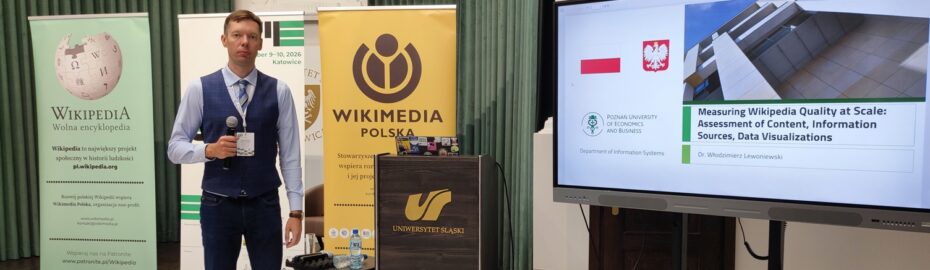
At the international conference “Open Knowledge: Wikimedia & Research in the CEE Region,” held on October 9–10, 2026, in Katowice, Dr. Włodzimierz Lewoniewski delivered a talk entitled “Measuring Wikipedia Quality at Scale: Assessment of Content, Information Sources, Data Visualizations.” The presentation explored how artificial intelligence and advanced data analysis techniques can help assess the quality of information available in the world’s largest online encyclopedia.
Wikipedia contains more than 65 million articles in over 300 languages. How can we determine whether such a vast body of knowledge is reliable, comprehensive, and properly documented? Manually reviewing every article would be virtually impossible. Researchers are therefore increasingly turning to automated analysis methods, including machine learning, natural language processing, and artificial intelligence models. These techniques make it possible to analyze millions of articles, identify potential quality issues, and compare content across different language editions of Wikipedia.
During his presentation, Dr. Włodzimierz Lewoniewski presented findings from research conducted at the Department of Information Systems, covering various aspects of Wikipedia quality – from article completeness and structure to the way information is presented and the sources used to support it. One of the examples discussed was a sentiment analysis of nearly 7 million articles from English Wikipedia. The presentation also covered research into connections between articles and methods for comparing the quality of information on the same topics across different language editions.
Another important part of the presentation focused on data visualizations, which help readers understand complex information. Is a chart easy to read? Does a map accurately represent the data? Does the way information is presented make it easier to understand? These questions were explored in research involving more than half a million visualizations from Polish Wikipedia, including maps, charts, tables, and diagrams. The studies examined their visual characteristics, readability, and effectiveness in communicating information.
A separate area of research concerned the sources used in Wikipedia articles. Analyzing hundreds of millions of citations and bibliographic references makes it possible to identify which websites Wikipedia contributors rely on most frequently, which sources dominate in particular fields of knowledge, and how their use varies across language editions. Such analyses provide valuable insights into where Wikipedia’s information comes from and how its network of information sources is structured.
One practical example of how these research findings can be applied is Wikipedia-Map.net, a new online service introduced during the conference. This freely accessible, interactive tool offers a different perspective on Wikipedia by presenting it as a map of interconnected articles. The current version focuses on the most popular articles from English Wikipedia. Users can explore relationships between topics, examine article popularity, and view automatically generated quality assessments. This makes it easier to see how different areas of knowledge are connected and how readers navigate between related topics. Wikipedia-Map.net also demonstrates how scientific research can lead to practical tools that make complex information structures more accessible to a wider audience.
The research presented at the conference highlights how artificial intelligence can play an important role in analyzing and improving open knowledge resources. However, automated quality assessment cannot fully replace human review. Key challenges include differences between languages, selecting appropriate AI models, and correctly interpreting quality indicators. The results of automated analyses should therefore be seen as tools for identifying potential problems rather than definitive judgments about the reliability of individual articles.
The methods being developed also have potential applications far beyond Wikipedia. They can support not only the continued improvement of the encyclopedia but also search engines, artificial intelligence systems, educational platforms, and other services that rely on open information resources. This demonstrates how research into the quality of online knowledge can contribute to technologies used by millions of people in their everyday lives.
The presentation materials are available on the “Open Knowledge: Wikimedia & Research in the CEE Region” conference website and on Figshare.