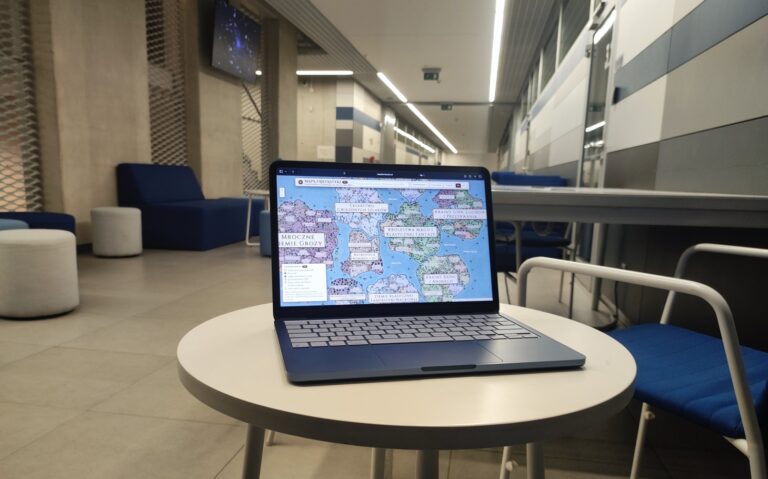
What would the world of human imagination look like if every novel, film, television series, play, video game, comic, myth and fictional character documented in the English-language Wikipedia had its own country on a single map? A new project, FictionMap.org, transforms around half a million encyclopaedia articles and more than nine million connections between them into an interactive atlas, revealing the hidden architecture of contemporary culture.
From Homer’s ancient epics and Norse mythology to Shakespeare’s plays, the great novels of the nineteenth century and the Golden Age of Hollywood, and onward to contemporary streaming series, Japanese manga, role-playing games and multibillion-dollar superhero universes, fiction forms a vast, ever-expanding network. Whenever we read a book, watch a film adaptation or look up the cast of a favourite television series in an encyclopaedia, we navigate an invisible network of cultural connections.
The Fiction Map seeks to turn this space into an actual map. Rather than presenting a conventional list of search results or an abstract network diagram resembling a tangled ball of thread, the project draws on algorithms from network science, computational geometry and procedural cartography. The result is a multiscale atlas of fiction built entirely from open data: the English-language Wikipedia, the Wikidata knowledge base, WikiRank and the Wikipedia Clickstream dataset, which captures actual patterns of reader navigation.
The scale of the project: a world of half a million territories
The map covers a broad spectrum of fictional culture documented in Wikipedia’s largest language edition as of 1 July 2026, drawing on twelve months of reader traffic from July 2025 to June 2026. Every article included in the atlas is assigned its own polygonal territory with a non-zero area, the size of which reflects reader interest.
- Around half a million territories (articles): from the global “metropolises” of popular culture to niche short stories, forgotten silent films and local folklore.
- More than 9 million weighted connections: combining the network of hyperlinks within Wikipedia articles with billions of actual reader transitions between articles.
- A three-tier geographical hierarchy: 16 thematic continents, 367 realms and 3,127 provinces.
- 20 territory categories (types): distinguishing not only media such as books, films, television series, theatre, games and comics, but also characters, fictional worlds, mythology, awards, studios, writers, creators and actors.
- 9 zoom levels (0–8): spanning a virtual canvas of 131,072 × 131,072 pixels, comprising 87,381 map tiles, complete with coastlines, straits, shipping routes and other geographical features.
Scientific and engineering challenges
Transforming raw Wikipedia and Wikidata datasets into a geographically coherent, smoothly functioning interactive map required addressing several non-trivial challenges at the intersection of network science, natural language processing, computational geometry and computer graphics.
Distinguishing fiction from non-fiction across millions of articles
The English-language Wikipedia contains more than seven million articles, while Wikidata contains over a hundred million items. At first glance, it might seem sufficient to retrieve all articles belonging to the “Fiction” category and its subcategories. In practice, however, Wikipedia’s category system is not a strict library classification scheme but a collaboratively constructed network of associations containing cycles and unexpected shortcuts.
Following just a few levels of subcategories related to “cultural depictions of historical figures”, “television programmes” or “podcasts” can lead a naive algorithm to include real-life politicians, athletes, historical battles, reality television shows, true-crime documentaries and current affairs commentary. To prevent this, the system combines several independent signals: Wikidata’s class hierarchy and properties (including P31 – instance of, P279 – subclass of, P136 – genre, P179 – part of the series, P106 – occupation, and relationships involving cast members and creators); Wikipedia categories; hyperlink structures extracted from full HTML dumps; and analysis of the opening sentences that define article subjects. The system also automatically excludes entire non-fiction series and their episodes.
Mapping a multidimensional cultural network onto a two-dimensional plane
Cultural connections form what is known as a small-world network, with relationships spanning many dimensions. Literary works such as Dune and The Witcher are connected to classic literature, cinema, television series, video games, comics and dozens of actors and creators working across other genres. Moreover, the project considers not only the hyperlinks embedded in Wikipedia articles but also Wikipedia Clickstream data: anonymised, aggregated statistics showing how readers actually navigate from one article to another.
Plotting such a dense graph directly, with more than nine million connections, would produce an unreadable cloud of points. To address this, the project first applies multilevel community detection using the Leiden algorithm, which groups articles so that connections within communities are strong and connections between communities are relatively sparse. The resulting continents, realms and provinces are then arranged using a force-directed layout, allowing spatial proximity on the map to reflect thematic relationships and patterns of reader navigation.
Balancing pop culture giants with niche works
The online popularity of articles follows a highly skewed, power-law distribution: the biggest releases attract millions of pageviews a year, while articles about nineteenth-century plays or forgotten video games from the 1980s may receive only a few hundred visits. If the area of each territory were directly proportional to its pageviews, a few dozen blockbuster titles would occupy almost the entire landmass, reducing hundreds of thousands of smaller articles to less than a single pixel. Conversely, assigning equal areas to all territories would obscure differences in popularity.
The project therefore uses power-law scaling with an exponent of γ = 0.50: the target area of a territory is proportional to P0.50, the square root of its popularity measure. In practice, this provides a clear visual compromise: a work that is 100 times as popular is assigned a territory ten times as large, rather than 100 times as large.
Sixteen continents of imagination: what emerged from the data?
None of the continents was predefined. Their boundaries and composition emerge from the network of encyclopaedic hyperlinks and readers’ navigation choices. The data revealed 15 major landmasses and an archipelago in the south of the map. The following list uses the original continent names displayed on the map:
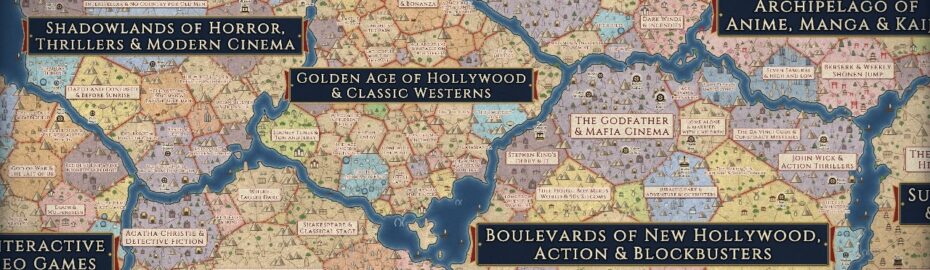
- Boulevards of New Hollywood, Action & Blockbusters – American gangster and action cinema (The Godfather, John Wick), major adventure and science fiction franchises (Jurassic Park, Alien, Avatar) and classic slasher horror.
- Shadowlands of Horror, Thrillers & Modern Cinema – contemporary auteur cinema, psychological thrillers, post-apocalyptic fiction, Stranger Things and the works of Christopher Nolan and Quentin Tarantino.
- Empire of Sitcoms, Animation & Prestige Serials – American television comedy, animated feature films (Shrek, Zootopia) and contemporary television dramas (Breaking Bad, Severance, The Bear).
- Crownlands of British Drama, Westeros & Stage (the continent with the most territories) – literature and theatre ranging from Shakespeare and the Brontë sisters to West End and Broadway musicals, BBC television series, the world of Harry Potter and Game of Thrones, with its strong ties to British actors.
- Subcontinent of Indian & Bollywood Cinema – a remarkably cohesive ecosystem of Hindi-language cinema, South Indian film industries (Tamil, Telugu and Malayalam) and the epic traditions of the Mahabharata and the Ramayana.
- Dominions of Primetime Drama, Procedurals & Starfleet – long-running television dramas, medical and crime series, alongside science fiction and supernatural television (Star Trek, The X-Files, Stargate, Buffy the Vampire Slayer).
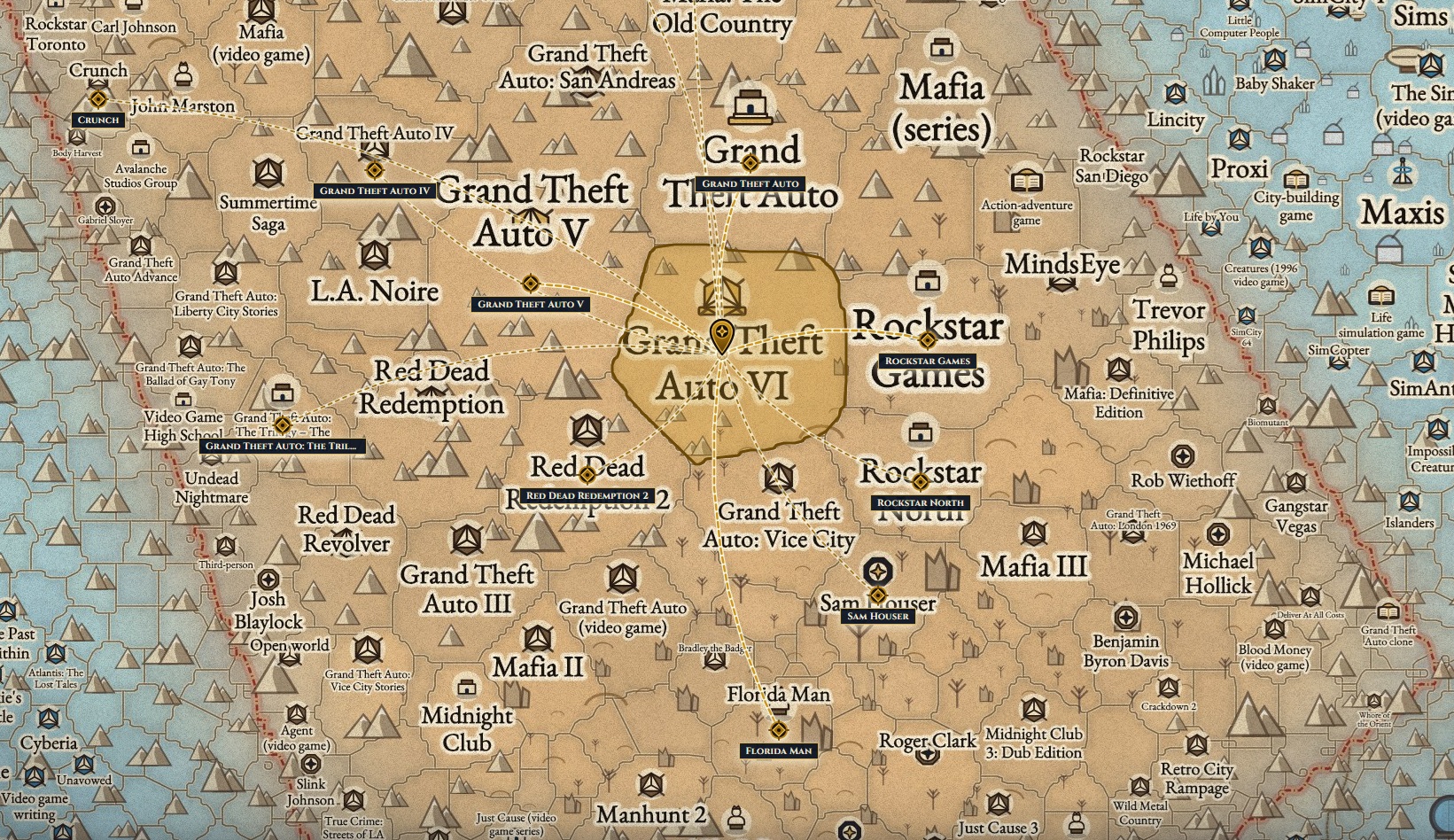
- Domains of Interactive Worlds & Video Games – computer games, console games, board games and role-playing games, from Super Mario and The Legend of Zelda to Grand Theft Auto, Resident Evil, The Last of Us, Dungeons & Dragons and Warhammer 40,000.
- Golden Age of Hollywood & Classic Westerns – classic twentieth-century studio cinema, westerns, musicals, Alfred Hitchcock’s films and the golden age of American animation (Looney Tunes, Tom and Jerry).
- Archipelago of Anime, Manga & Kaiju – Japanese animation and comics (One Piece, Dragon Ball, Demon Slayer, Neon Genesis Evangelion, Pokémon), as well as giant monster films, most notably Godzilla.
- High Kingdoms of Myth, Middle-earth & Lore – world mythologies (Greek, Norse, Celtic, Mesoamerican and Polynesian), Arthurian legends and J. R. R. Tolkien’s Middle-earth, rooted in philology and myth.
- Celestial Empires of East Asian Cinema & K-Drama – South Korean television and cinema (Squid Game, Parasite), Hong Kong cinema, the Chinese traditions of wuxia and xianxia, and Journey to the West.
- Citadels of Marvel, DC & Comic Worlds – superhero universes in comics and film (Marvel, DC, Watchmen, Invincible), alongside classic newspaper comic strips and European comics (Peanuts, Tintin, Lucky Luke).
- Continental Boulevards of European Cinema – French, Italian, German, Scandinavian and Central European cinema, including Polish works documented in the English-language Wikipedia, alongside classic European fiction.
- Grand Libraries of Literature, Sci-Fi & Dystopia – the canon of the modern novel, classic dystopian fiction (Nineteen Eighty-Four, The Handmaid’s Tale), hard science fiction (Isaac Asimov’s works, The Three-Body Problem) and the Cthulhu Mythos.
- Meridians of Iberian & Latin American Cinema – Spanish-language and Brazilian film and television (Money Heist, Pan’s Labyrinth, City of God), alongside telenovelas.
- Forgotten Archipelago – a chain of small islands representing isolated clusters of works with relatively few connections to the main continents.
Opportunities and benefits: what can a bird’s-eye view of culture reveal?
Breaking out of the recommendation bubble
The algorithms used by streaming platforms and online retailers generally suggest more of what audiences already know. The map works differently, encouraging serendipity – the discovery of something unexpected and rewarding. By exploring the borders between realms, users can discover works that bridge seemingly distant styles and genres. They can also use twelve filters to highlight major hubs within a selected category, such as plays, fictional worlds, games or mythology; trace connections to the twenty closest neighbours of a selected article in the network; or explore an unfamiliar territory at random using the Discover button.
A laboratory for digital humanities and Wikipedia research
For scholars of culture and media, Fiction Map offers a practical application of distant reading, a concept proposed by literary scholar Franco Moretti. It makes it possible to observe patterns that are difficult to detect when studying individual works: how high-profile adaptations draw novels towards audiovisual clusters, which film industries form self-contained continents and which overlap with the English-speaking cultural sphere, and how shared casts connect seemingly unrelated genres.
Clicking on any territory opens its territory chronicle, which displays annual pageviews and popularity rankings alongside the WikiRank article quality score (on a scale of 0–100), as well as direct links to Wikipedia, Wikidata and WikiRank. For Wikipedia editors and open knowledge researchers, this can serve as a diagnostic tool: it makes it easy to identify large territories representing topics that attract considerable reader interest but have low article quality scores and could benefit from further improvement.
Why do unexpected patterns and potential errors occur? The role of Wikipedia and Wikidata
A fundamental principle of the Map of Fictional Worlds is that no article is manually positioned on the map. None of the roughly half a million articles has been relocated to match an editor’s intuition. Instead, the atlas is an algorithmically generated representation of data contributed by volunteers to Wikipedia and Wikidata. As a result, observant users may encounter intriguing anomalies, unexpected neighbours or occasional classification errors. These arise primarily from the following six factors.
Data quality, incompleteness and inconsistency in Wikipedia and Wikidata
The classification system depends on the information available in Wikidata’s structured fields, Wikipedia’s categories and other article-level signals. Because both resources are collaboratively developed and continually edited by hundreds of thousands of contributors, the consistency and completeness of their data can vary considerably:
- Unusual or missing classifications in Wikidata: a popular streaming television series may be classified solely as a “web series” (
Q526877) rather than a “television series”, while a lesser-known novel or play may lack an assigned genre (P136) or standard Wikipedia categories. Without additional corrective rules, such an article could be assigned an imprecise label or fail to meet the criteria for inclusion on the map. - Errors in the conceptual hierarchy (a form of ontology drift): a single inaccurate superclass relationship (
P279– subclass of) in Wikidata can have a cascading effect. For instance, placing general entertainment podcasts and review programmes under the class “fiction podcast” would cause a straightforward database query to treat discussions about films as fictional audio dramas. - Conflation of two people in a single record: occasionally, a single Wikidata item identifier (QID) mistakenly combines biographical information about two different people who share the same name, such as a contemporary media personality and a pre-war screenwriter, thereby attributing film credits to someone with no connection to fictional works.
Cross-genre and cross-media gravity
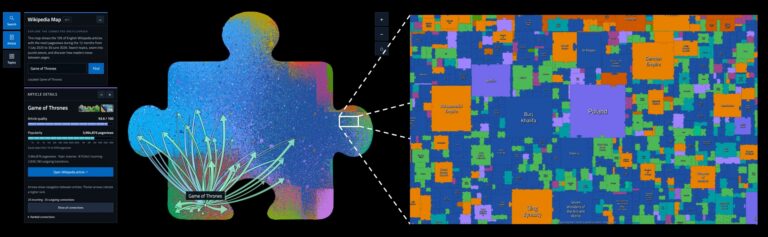
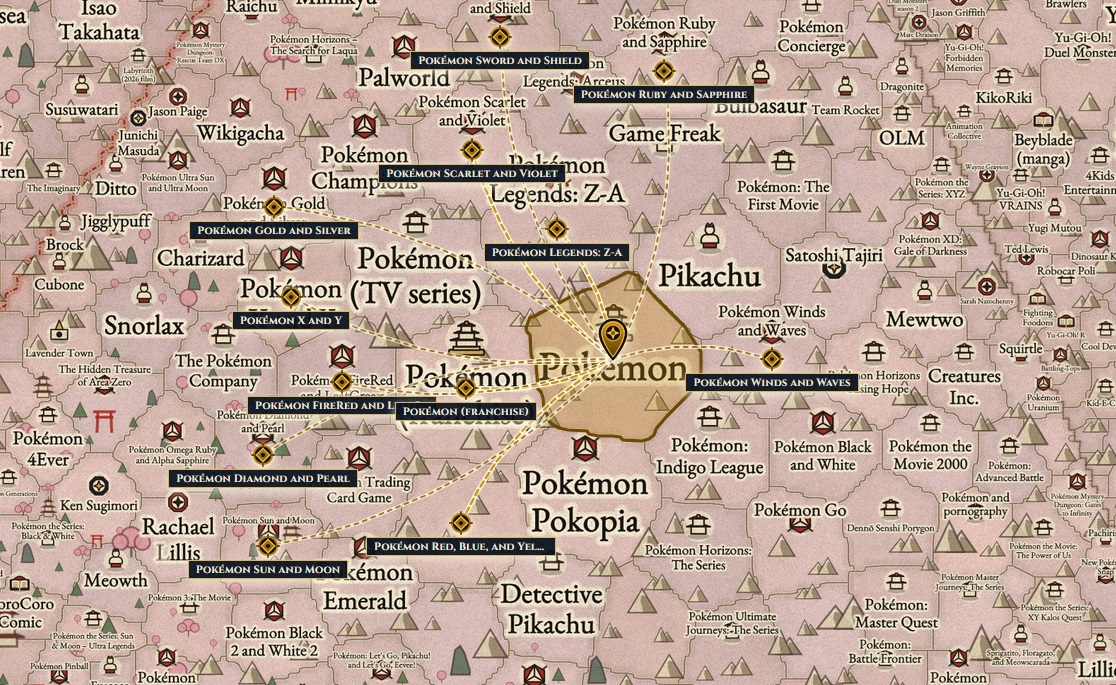
On a two-dimensional map, each article can occupy only one location, whereas major franchises span several media simultaneously. For example, although Pokémon originated in games released for Nintendo consoles, it is located not in the Super Mario, Zelda & Nintendo realm on the video game continent, but in the Pokémon & Yu-Gi-Oh! realm within the Archipelago of Anime, Manga & Kaiju. The reason lies in the data: more than 1,200 anime episodes, over 20 theatrical films, manga, voice actors and the trading card game collectively generate a much stronger network of hyperlinks and reader transitions towards Japanese animation and Yu-Gi-Oh! than towards Nintendo platform games in the English-language Wikipedia. Similarly, Game of Thrones appears on the British drama continent, drawn there by the hundreds of British stage and television actors in its cast.
Geometric compromises in a two-dimensional landscape
Flattening a network of nine million connections into two dimensions inevitably involves spatial compromises. Two provinces that meet at the boundary between realms are not necessarily closely related in genre. Their proximity may result from a shared composer, a director working across several genres or simply the need to fill a continent with polygons without leaving gaps. Likewise, the cardinal directions on the map – north, south, east and west – serve purely compositional purposes and do not correspond to Earth’s physical geography.
The blurred boundaries between myth, history, biography and fiction
In culture, there is no sharp dividing line between historical fact and literary invention. Ancient epics, apocryphal texts, folktales, semi-legendary figures, dramatised biographical films and historical rulers who appear as characters in Shakespeare’s plays all lie at the intersection of these domains. Even after rigorously filtering out purely historical scholarship, journalism and documentaries, the classification of individual Wikipedia and Wikidata entries in these grey areas can remain ambiguous.
The snapshot effect and high-profile releases
Territory sizes reflect twelve months of reader traffic, from July 2025 to June 2026. Within this time window, a major theatrical release, a new season of a television series or the viral success of a video game can multiply an article’s pageviews, giving a recent work a larger territory than a classic novel with steady, long-standing popularity. Square-root scaling (P0.50) substantially reduces these disparities without eliminating them entirely. As a result, the atlas also captures what was attracting public attention at a particular moment in time.
The English-language perspective
Although the English-language Wikipedia is one of the world’s most comprehensive encyclopaedic resources, its content and readership statistics primarily reflect the interests of readers who use English. American, British and Indian productions, Japanese anime and South Korean television series are often documented in remarkable detail, sometimes down to individual episodes. Meanwhile, significant works from smaller national literary and cinematic traditions, especially those that have not been translated into English, may be less extensively represented or may still lack dedicated articles.
Paradoxically, these unexpected neighbours and minor imperfections in the data are part of what makes FictionMap.org such an interesting subject of exploration. Rather than presenting an idealised library catalogue, the map offers a living picture of how today’s internet users collectively document, connect and discover stories.
The Map of Fictional Worlds demonstrates how open data from Wikimedia projects, combined with methods from network science and computational cartography, can reveal the collective achievements of human imagination as a single interconnected ecosystem. For readers, viewers and gamers, it is an invitation to explore familiar and undiscovered realms of culture. For researchers and Wikipedia and Wikidata editors, it provides a detailed map of both the vast body of knowledge already assembled and the gaps that remain to be filled.